
On Creative Collaboration: Mark Foss & Spoon Jackson
In his own words, Mark describes the evolution of his and Spoon's joint projects, and notes how collaborative work often generates ongoing cycles of connection.

Mark Foss — I was not one of those kids who plays well with others. In journalism school, I often struggled to work with a “team” to produce a newspaper, a radio show or a television broadcast. Perhaps that’s why I never became a journalist. Instead, after working in communications for two foreign aid groups, I became a writer/editor who worked from home.
When I began taking creative writing workshops in the 1990s, I finally discovered the pleasures of collaboration. We were not working on a joint project, but we still supported each other in our own journeys. I welcomed the constructive criticism that I received and honed my skills in providing respectful feedback to others.
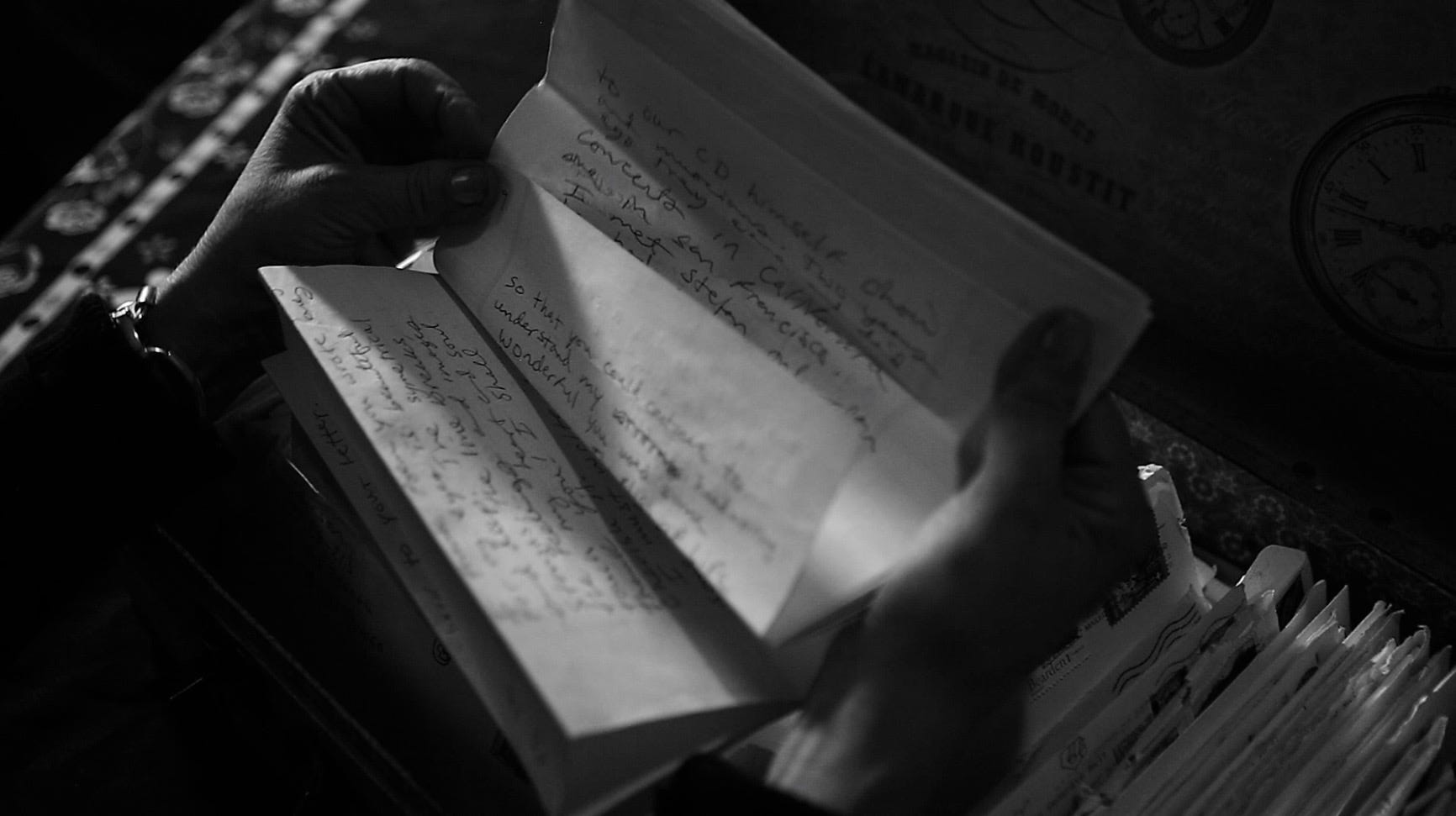
The roots of my collaboration with Spoon Jackson date to the mid-2010s. My partner, Michka Saäl, was making a film about how Spoon discovered poetry while serving a life sentence without the possibility of parole in California prisons. The film, simply called Spoon, was conceived as a poetic and political exchange imprinted on the dunes of the Mojave Desert and her interior landscapes. I drove the team around the desert, but Spoon and I had not connected during the production. We met for the first time when he called with condolences in July 2017 — the day after Michka died from an illness. Thus began a steady stream of calls, letters, emails and texts between us that continues to this day.
Click here to read Mark’s interview with Spoon about his relationship and collaboration with Michka and their film.
Our sharing first turned to collaboration in 2019 following the death of Judith Tannenbaum, the teaching artist who introduced Spoon to poetry at San Quentin. Spoon wanted to prepare a commemorative book of essays, poems and recollections from former students, friends and other teaching artists of how Judith had touched their lives. I signed on as a co-editor, teaming up with Spoon and Judith’s daughter Sara Press to bring his vision to reality. I worked with contributors to polish their words and developed a prospectus to convince the publisher it was a viable idea.
At first, I had hesitated to volunteer for the editing role. I worried it would take too much time from my own writing. However, it turned out to be a rewarding and uplifting experience. I appreciated the deep gratitude of the contributors towards Judith, and I was pleased to help them shape their words as needed.

Our collaboration began in October 2020, just as the second wave of the pandemic began to shut down the world. As my social life went largely virtual, working with Spoon’s contributors became a much-needed lifeline. More than that, when I learned what COVID meant inside a prison, it put the idea of “lockdown” in Montreal into a larger context.
While Spoon was recovering from COVID, I would email him the draft poems and essays for his comments and make a list of points to go over on our next telephone call. Always, by the time we spoke, his network had updated him on whose pieces had arrived and whose were delayed. I began to realize just how much his leadership from prison was driving the whole project.
In 2022, New Village Press, which had previously published a joint memoir by Spoon and Judith, published our homage to her called The Book of Judith. Since then, I have continued to work with Spoon in different ways. Sometimes, he will read different versions of poems or songs over the phone, and I will offer feedback. Recently, I told him about a call for poems from a journal with the theme of “Anew”. He wrote new poems and dictated them over the phone, and I typed them up and sent them. They were not accepted, as often happens, but Spoon was typically upbeat: “It is their loss! They will eventually get into the world! Thanks!”
Other times, he will dictate opinion pieces for newspapers that I will type up and then edit collaboratively with him. When a piece about visitation was rejected recently, I suggested that he add more details. He wrote back: “Sounds great to me and I know since I have more distance from that situation, I can add more layers to the article and restructure! I am sure it will come out better!”
In January 2026, the film Spoon was shown for the first time in the US at Circle Cinema Theatre in Tulsa, Oklahoma. It was part of a film and art exhibit featuring the work of incarcerated artists organized by JustArts, a non-profit group that “centers and celebrates the creative work of people who are incarcerated, affirming their voices and visions as vital parts of our cultural landscape.”
The founder of JustArts was a friend of Spoon’s with whom I had worked virtually through The Book of Judith. In this sense, the screening was an extension of our work together on Spoon’s homage to Judith Tannenbaum. When the seeds of collaboration are planted, we never know where they will sprout.
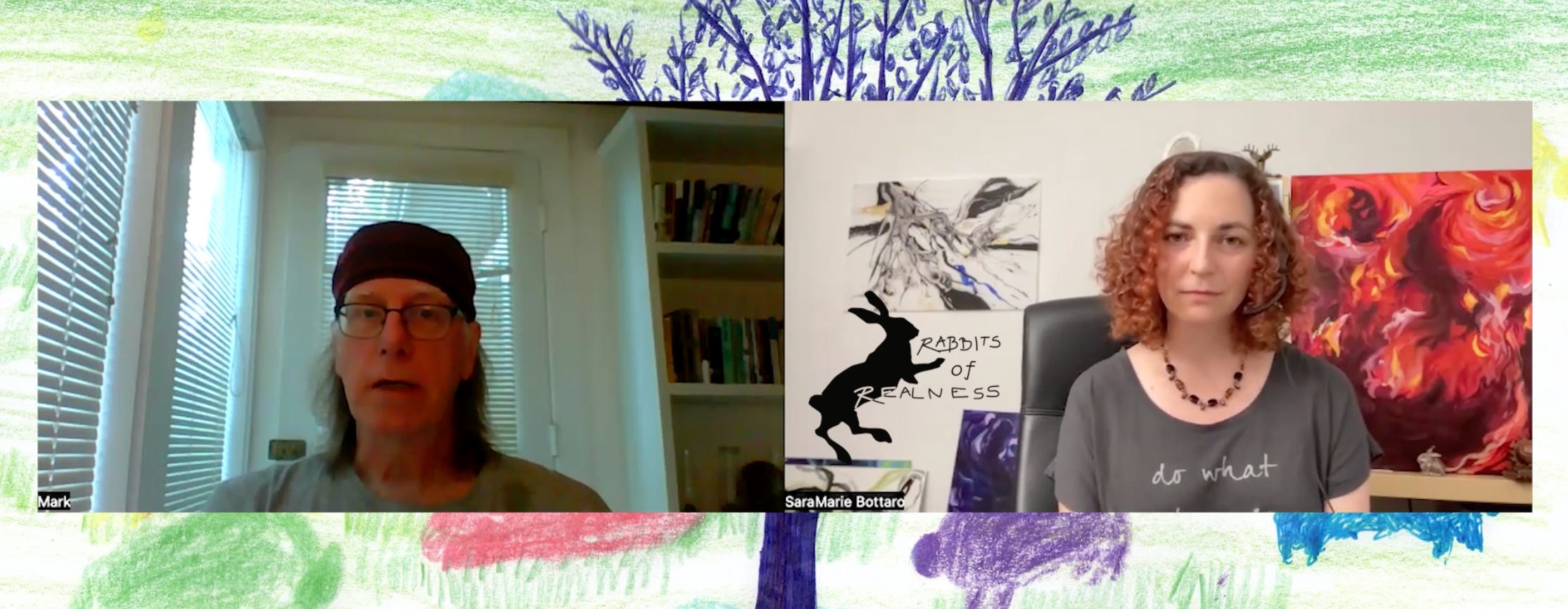
Click here to watch Rabbits of Realness’ interview with Mark. To see more of Mark’s work, take a look at his website.